
Cage-Free / Open Play in Raleigh, NC
A guide to Raleigh's 8 cage-free, open play dog day care centers: what open play means, what to check before enrolling, and how our rankings work.
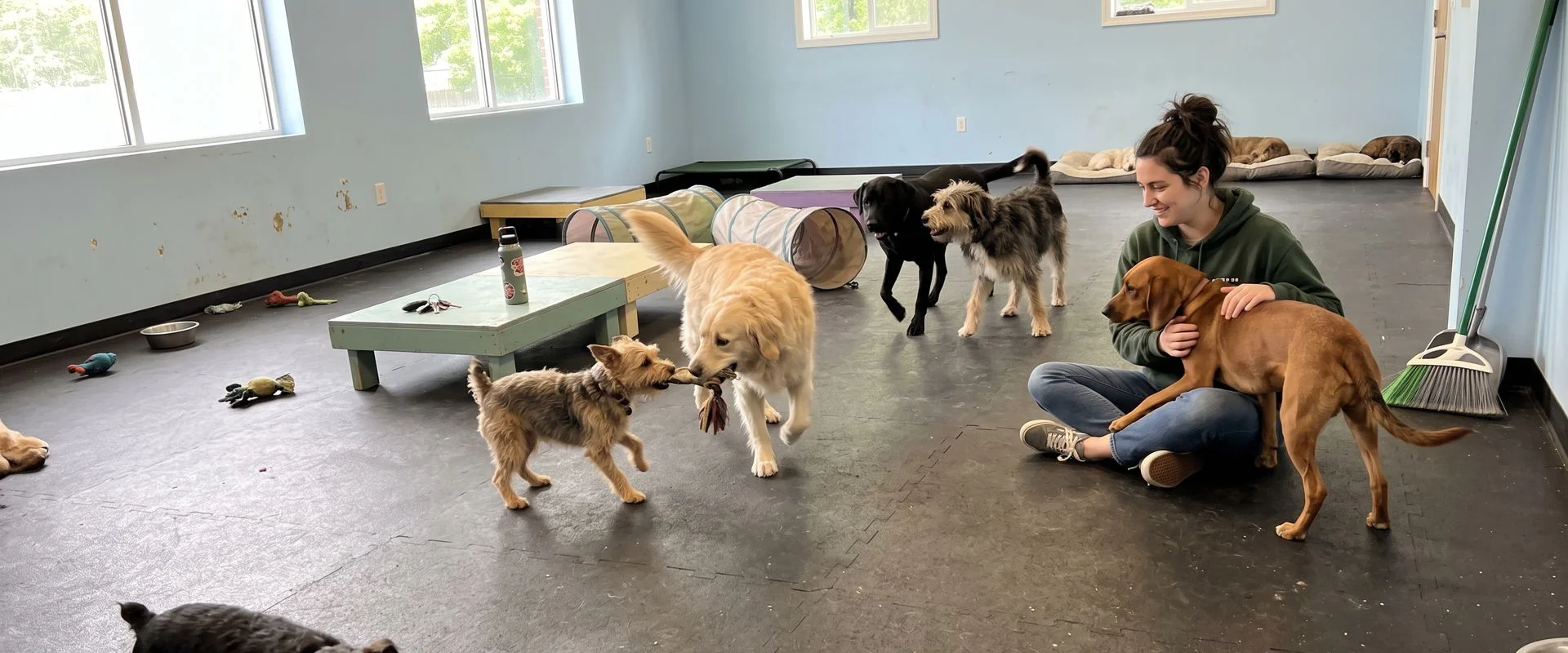
Cage-free, or open play, day care means dogs spend the day loose in a supervised group setting rather than rotating in and out of individual kennels. In Raleigh, that usually looks like a large indoor space with rubber or turf flooring, sometimes an attached outdoor yard, and staff walking the floor to break up rough play and manage groups by size or temperament. It's the model most people picture when they think of "doggy day care," and it's what all 8 businesses in this category offer, though the details of how they run it vary quite a bit.
Not every dog does well in an open play setting. High-energy, social dogs tend to thrive; dogs that guard space, get overwhelmed in groups, or have a bite history usually need a smaller or more structured environment instead. Before enrolling, ask how staff group dogs (by size, age, play style), what the staff-to-dog ratio actually is on a busy day, and what the evaluation or trial day involves. Also ask what happens when a dog needs a break: is there a quiet area, or are dogs in the mix for the entire visit? Flooring, ventilation, and how quickly a facility separates dogs who aren't getting along are the details that separate a well-run open play room from a chaotic one.
Our scoring weighs staff supervision and ratios, facility cleanliness and safety, temperament screening on intake, and how consistently a business delivers a calm, well-managed group environment rather than just a big open room. See the full breakdown in our methodology, or jump straight to the ranked guide to Raleigh's best dog day care centers to compare all of them side by side.
Find a spot for cage-free / open play in Raleigh, NC
Tell us what you need and we'll connect you with suitable daycare centers in your area. It's free and no obligation.
All cage-free / open play in Raleigh, NC, ranked by score and relevance
0 businesses, scored on recent reviews. The order weighs each business's overall score by how much of its reviewed work is cage-free / open play, so a lower-scored specialist can rank above a higher-scored generalist.
Enquiries submitted through our forms may be shared with partner providers who can do the work, and we may receive a referral fee. Our rankings and scores follow our published methodology only and are never affected by referral fees.
Common questions about cage-free / open play
- How much does cage-free dog day care cost in Raleigh?
- Most open play day cares in the Raleigh area charge somewhere in the range of $25 to $40 for a full day, with some offering discounted multi-day packages or monthly memberships that bring the per-day cost down. Half-day rates, when offered, usually run a bit less. Prices vary based on group size, facility amenities, and whether add-ons like grooming or extra playtime are bundled in.
- How often should I bring my dog to day care?
- One to three days a week is typical for dogs that need regular socialization or exercise while their owner works. Puppies and high-energy breeds often do well with more frequent visits, while older or lower-energy dogs may only need occasional days. Most facilities recommend starting with one or two trial visits to see how your dog handles the group before committing to a regular schedule.
- What should I expect on my dog's first day?
- Nearly every cage-free facility requires a temperament evaluation or trial day before regular enrollment, plus proof of vaccinations (rabies, DHPP, and often bordetella or canine flu). Expect staff to introduce your dog to the group gradually, sometimes in a smaller area first, and to call you if there's any sign your dog isn't adjusting well to open play.
- How can I tell if a day care is well run?
- Ask to tour the play area in person rather than relying on photos. Look for a reasonable staff-to-dog ratio (roughly one staff member per 10-15 dogs is a common benchmark), clean but not overly sterile-smelling floors, dogs grouped sensibly by size and energy, and staff actively moving through the room rather than watching from the sidelines. A facility that's willing to explain its intake screening and separation policies in detail is usually one that takes safety seriously.