
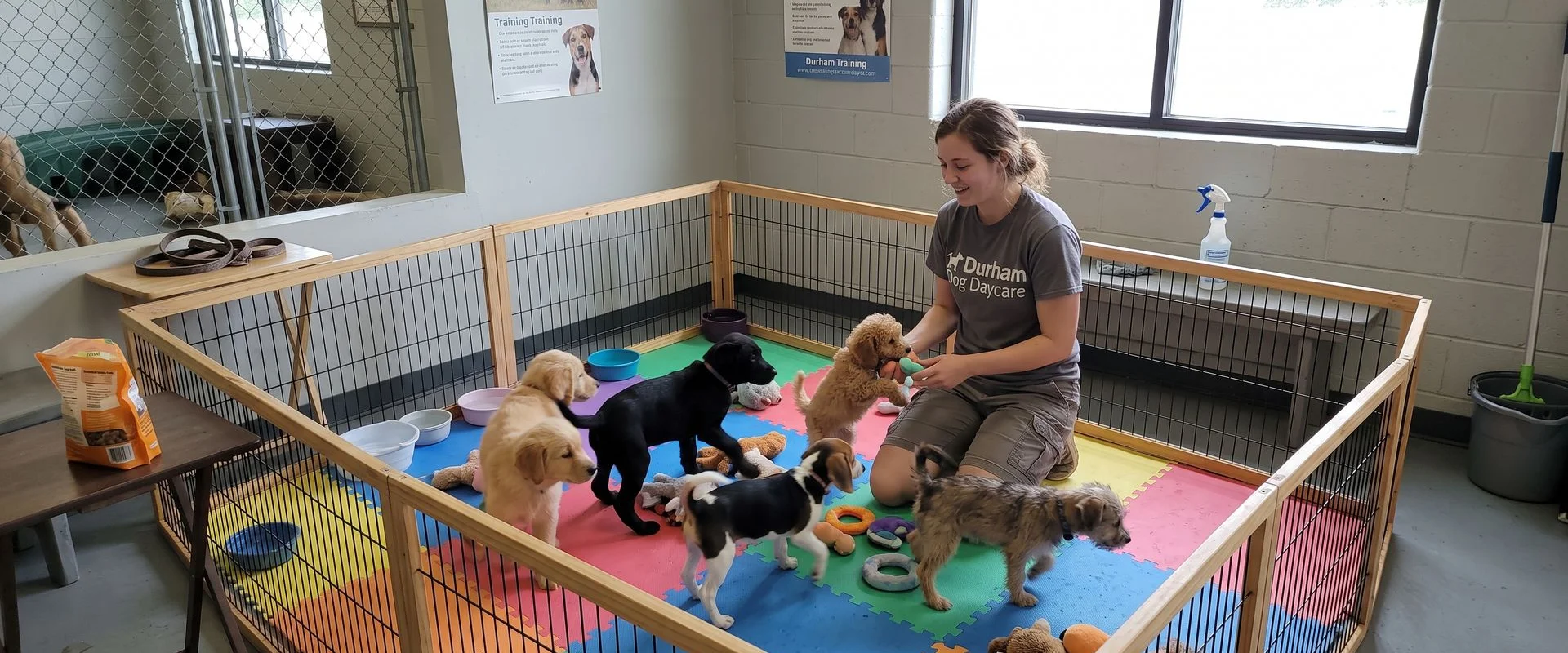
Puppy Programs in Chapel Hill, NC
A guide to puppy day care programs in Chapel Hill, NC: what's included, what to check before enrolling, and how our rankings compare 12 local providers.
Puppy programs are a specialized version of day care built around dogs under a year old, roughly. Instead of turning a young pup loose in a general adult play group, providers separate puppies by size and play style, cap sessions to manage overstimulation, and weave in the basics: house training reinforcement, crate comfort, handling exercises, and exposure to new sounds, surfaces, and people during the critical socialization window. Chapel Hill has 12 businesses offering some version of this, ranging from dedicated puppy playrooms inside larger day care facilities to smaller operations that limit puppy intake to a few spots per day.
What to look for before enrolling
Not every "puppy friendly" day care actually separates puppies from bigger, older dogs during play. Ask directly whether puppies get their own group, how staff manage nap breaks (young pups tire fast and need enforced rest, not just free-for-all play all day), and what the vaccine and deworming requirements are before a puppy can attend. Staff-to-puppy ratio matters more here than in adult day care, since puppies need more redirection and closer supervision. It's also worth asking how a facility handles a puppy who gets overwhelmed or nips too hard, since how staff coach that moment shapes a dog's long-term behavior.
How we score providers
Our rankings weigh staff training and supervision, facility safety and cleanliness, health and vaccine protocols, communication with owners, and verified customer feedback. Full detail on how each factor is weighted is on our methodology page. For the complete ranked list of Chapel Hill day care centers, including how the puppy-specific providers stack up against general day care operators, see our best dog day care centers in Chapel Hill, NC guide.
Find a spot for puppy programs in Chapel Hill, NC
Tell us what you need and we'll connect you with suitable daycare centers in your area. It's free and no obligation.
All puppy programs in Chapel Hill, NC, ranked by score and relevance
0 businesses, scored on recent reviews. The order weighs each business's overall score by how much of its reviewed work is puppy programs, so a lower-scored specialist can rank above a higher-scored generalist.
Enquiries submitted through our forms may be shared with partner providers who can do the work, and we may receive a referral fee. Our rankings and scores follow our published methodology only and are never affected by referral fees.
Common questions about puppy programs
- How much does puppy day care cost in Chapel Hill?
- Most facilities charge close to standard day care rates, generally in the $25-$40 per day range locally, though some offer discounted puppy-specific half-day sessions since young pups often can't handle a full day of stimulation. Multi-day packages or monthly passes usually bring the per-visit cost down.
- How often should a puppy go to day care?
- One to three days a week is typical for socialization purposes. Puppies need plenty of rest between sessions since their nervous systems are still developing, so daily attendance isn't necessary or always advisable unless a household needs full-time supervision for other reasons.
- What should I expect on a puppy's first day?
- Expect a shorter first visit, often just a few hours, so staff can observe how the puppy handles new dogs and the environment before committing to a full day. Most facilities will ask for proof of vaccines (at minimum the initial puppy series in progress) and may separate a new puppy for a supervised meet-and-greet before joining group play.
- How can I tell if a puppy program is actually good quality, not just marketing?
- Visit in person and watch a play session if allowed. Good programs keep puppy groups separate from adult dogs, enforce rest breaks, keep groups small enough for staff to intervene quickly, and can explain their vaccine and health screening rules without hesitation. Vague answers about supervision ratios or group sizes are a warning sign.